BFCM: Baby First. Chaos Managed. . Free $50 Gift Voucher . Feeling Generous . Money Back Guarantee . Free Shipping over $100 . Sharing is Caring
✓ BFCM: Baby First. Chaos Managed.✓ Free $50 Gift Voucher✓ Feeling Generous✓ Money Back Guarantee✓ Free Shipping over $100✓ Sharing is Caring✓ BFCM: Baby First. Chaos Managed.✓ Free $50 Gift Voucher✓ Feeling Generous✓ Money Back Guarantee✓ Free Shipping over $100✓ Sharing is Caring✓ BFCM: Baby First. Chaos Managed.✓ Free $50 Gift Voucher✓ Feeling Generous✓ Money Back Guarantee✓ Free Shipping over $100✓ Sharing is Caring✓ BFCM: Baby First. Chaos Managed.✓ Free $50 Gift Voucher✓ Feeling Generous✓ Money Back Guarantee✓ Free Shipping over $100✓ Sharing is Caring
Will My Dog Be Okay? Everything We Did to Prepare Buddy for Joy's Arrival
This article uses a custom page template. Content is managed in the Liquid section file.
Family & Dog Life
Will My Dog Be Okay? Everything We Did to Prepare Buddy for Joy's Arrival
The question every dog owner asks the moment those two lines show up.
By Marieke, Founder of Buddy & Joy10 min readBased on our experience with Buddy and Joy, with guidance from recognised animal-welfare, veterinary and dog-and-baby education resources.
When I found out I was pregnant with Joy, the excitement came with a question I was not expecting to feel so strongly: what about Buddy? He had been my shadow for years, my walking buddy, my first baby in a lot of ways, and I lay awake wondering if he would feel replaced. Turns out I was worried about the wrong thing entirely.
This is everything we went through, from the pregnancy months, through bringing Joy home, right through to where we are now with a toddler and a dog who adore each other. This guide combines what we experienced with guidance from recognised animal-welfare, veterinary and specialist dog-and-baby education resources. Our story is personal to Buddy and Joy. The practical guidance is supported by the sources linked throughout each article, so readers can explore the original advice for themselves.
We hope that our experience and research is helping you on your journey. If it even helps just one new mum and dog, it was worthwhile writing this all down. Each part ends with its own printable checklist, so you can come back to exactly what you need without scrolling through the whole thing again.
This is the part nobody really prepares you for either. You are growing a whole new person, adjusting to symptoms, appointments and a changing body, and somewhere in there you are also meant to prepare your dog for a change he has no way of understanding in advance. The good news is you do not need to do it all in one weekend. A little groundwork, spread gently across these nine months, makes the whole transition softer, for both of you.
Buddy, keeping close watch over the bump, months before Joy arrived.
This photo is one of my favourites from the whole pregnancy. Buddy started parking himself beside my bump on his own, no training, no treats, just something he decided to do. I remember sitting very still so I would not disturb him, half amazed and half already crying about it (pregnancy hormones do not discriminate). I did not plan for that moment, but looking back, it was the start of him adjusting long before Joy ever arrived.
Training, especially recall
I will be honest, training was not high on my list of things I felt like doing in my third trimester, and if I am honest again, recall is the one thing I wish we had worked on properly before Joy arrived. This is exactly the window the RSPCA points to: before the baby comes is when your dog most reliably learns to sit, stay, lie down and come, because you still have the time, patience and energy to practise it properly. Once your hands are full of a newborn, a nappy bag and whatever else you are juggling, a dog who comes back the first time you call is not a nice-to-have, it is what lets you actually relax on a walk.
Buddy was never a puller, if anything his stubborn streak shows up differently. He will flatly refuse to move when it is time to leave the park, lying down like the walk is simply over when he decides it is over. Better recall would certainly have saved me from a lot of standing around, bribing and waiting him out. Instead I spent a lot of afternoons standing there, coaxing, bribing, occasionally just waiting him out. If you take one thing from this section, let it be that one. We did not get everything right, and this is one I would go back and fix.
These are the four we would prioritise, and no, we did not get full marks on all of them either.
Recognised veterinary and animal-welfare guidance recommends teaching useful behaviours before the baby arrives, while there is still time to practise them gradually. RSPCA Australia specifically identifies sit, stay, lie down and recall as valuable skills when preparing a dog for a newborn. The American Veterinary Society of Animal Behavior recommends using reward-based methods for all dog training and behaviour modification.
Recall
The one we would redo if we could. A dog who comes back every time means you can relax, even with your hands full.
Leave It
A genuine lifesaver once the nursery fills up with things a curious nose finds fascinating.
Place
Gives your dog somewhere to settle without feeling shut out, for the moments you need both hands free.
Sit & Stay
Makes feeds, nappy changes and floor time so much calmer for everyone.
Adjust routines gradually
Dogs are creatures of habit, more than we sometimes give them credit for. Shifting walk times, attention patterns and sleeping arrangements gradually, a few months out rather than in the last frantic week, means the change lands as a gentle drift instead of a shock on top of everything else that is about to change in his world.
Preparing changes in advance is also supported by recognised animal-welfare guidance. RSPCA Australia recommends introducing changes to routines and sleeping arrangements before the baby arrives, giving the dog enough time to learn and adjust rather than facing every change at once.
Set up support for your dog early
Look into dog daycare or a walker now, while you still have the headspace to research it properly, not three weeks postpartum running on no sleep. Give it a few months so it becomes something your dog genuinely looks forward to, not a strange new person showing up the same week his whole household changed. And I want to say this plainly: getting help for your dog is not failing him. It is one of the kindest, most practical things you can do for both of you.
The care arrangement does not need to look the same for every family. Some dogs may be most comfortable staying at home with a familiar person. Others may be happy with a trusted walker, family member, daycare provider or holiday carer they already know. The most useful preparation is to introduce the arrangement before it becomes urgent and confirm a backup option where possible.
Introduce new things gradually
Try not to rearrange the whole house in one weekend. Bring in the cot, bouncer, pram, change table and toys one at a time, and let your dog have a proper sniff and investigate each piece before the next one arrives. Buddy treated every new arrival like it needed a full inspection, and honestly, I let him. It seemed to help him feel like part of the process rather than a bystander to it.
Gradual familiarisation can help make new equipment, sounds and movements less surprising. Let your dog investigate at their own pace and pair calm behaviour with rewards. Do not force them towards an object they are worried about.
Buddy, giving one of Joy's new toys a very thorough inspection.
Buddy and the bike
Buddy has never been a puller. If anything, it is the opposite. As a puppy, he once launched himself at a passing bike in pure over-excitement and got his paw caught in the spokes. I can still hear him yelping. Nothing serious came of it physically, but it left a mark on him all the same, and ever since, he has been a little wary of anything with wheels. A pram rolling along beside him was never going to be the exception. That is a big part of why we put so much deliberate effort into the pram practice below, not to stop him pulling toward it, but to help him feel safe walking calmly next to it.
Not every dog carries that same wariness though. Plenty of larger, high-energy dogs get thoroughly overexcited the moment they realise a walk is happening, and pulling is the result. If that is your dog, a
is genuinely worth having in place before the baby comes, so you can keep both hands on the pram at all times, whichever way your dog's excitement shows up.
Practise walking beside a pram
Start with an empty pram on your usual walking routes. Reward the calm moments. By the time there is a baby in it, the pram should feel more familiar and less surprising to your dog.
Still walking Buddy right up until the end, bump and all.
Introduce baby sounds, and the sight of a baby too
Introduce baby sounds at a very low volume while your dog is relaxed. Pair the sounds with something positive and increase the volume gradually only while your dog remains comfortable. If your dog becomes worried, reduce the intensity or stop and seek professional guidance where needed. Reward-based, gradual exposure is consistent with the humane training principles recommended by the American Veterinary Society of Animal Behavior.
It is not just the sounds either. Get your dog used to seeing you carry something the size and shape of a baby around the house too, a wrapped bundle, a doll, even just a rolled blanket held against your chest. Walk around with it, sit down with it, potter about the kitchen with it. Your dog will pick up on the change in how you move and hold your arms long before he understands why, so let that be familiar before it is actually Joy in your arms.
Don't panic if your dog leaves the room. Honestly, that's the safe, sensible response, they're removing themselves from something uncomfortable rather than reacting badly. What you're working toward isn't a dog who's numb to crying, it's one who can stay calm in the same room.
Check health and vaccinations
Pain, illness or discomfort can affect a dog's behaviour and tolerance. Before the baby arrives, arrange a veterinary health check and make sure vaccinations, worming and external parasite prevention are current.
Use the appointment to raise any behavioural concerns too, including fear, guarding, reactivity, irritability or difficulty coping with changes.
RSPCA Australia recommends checking both physical and behavioural health as part of preparing a dog for a newborn. Where there are concerning behaviours, seek help from a veterinarian with expertise in behaviour or a suitably qualified reward-based behaviour professional before the baby arrives.
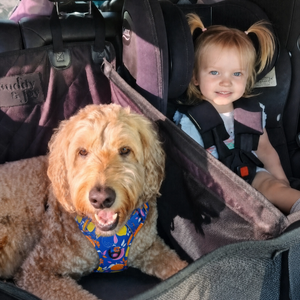
Getting out together starts in the car.
Buddy and Joy, settled in on the way to their favourite park. This is what the Hammock was actually built for.
Gives your dog and baby their own defined space, every trip
Non-slip base and seat anchors, tested to support up to 180kg
Integrated door panel keeps muddy paws off your interior
Hands-free to load, no clips or zips to fumble with
The groundwork you lay now will not feel like much at the time. It will feel like everything once you are home with a newborn and a dog who already knows what calm looks like.
Your fourth trimester plan (the first 12 weeks)
The fourth trimester is not the time to also be auditioning for perfect dog parent of the year. Plan now, while you can still think clearly, so you are not making these decisions later on no sleep.
Your due date is an estimate, not a certainty, and labour does not check your calendar first. Make sure you have someone, ideally more than one someone, who can collect your dog at short notice, day or night, and actually confirm it with them rather than assuming. Pack a bag for your dog the same way you pack your own hospital bag: food, lead, any medication, his bed or blanket if he settles better with something familiar. We would genuinely recommend your dog stays with family or a friend for those first few days, rather than at home with a house-sitter, and only comes back once you have had a chance to settle in yourselves. Coming home to a full, unfamiliar house is a lot for a dog to walk into on day one.
Confirm at least one, ideally two, people who can collect your dog at short notice, any time of day or night
Pack a bag for your dog, just like your own hospital bag: food, lead, any medication, something familiar like his bed or blanket
Plan for your dog to stay with family or a friend for the first few days, then come home once you are settled
Trial daycare in advance too, if that is the route you are considering
Brief your support person properly, routine, commands, quirks, all of it
Make sure whoever is walking your dog has the right lead and harness for them
Made it through Part 1?
Grab the Phase 1 checklist, every practical step from this section in one printable page, so you are not scrolling back through here once you are elbow-deep in nursery setup.
This part covers the two moments that mattered most for us, the days I was away having Joy, and the day Buddy finally met her. We settled in at home first, a friend brought Buddy back from his walk once things were calm, and the actual introduction happened once everyone, dog included, was ready for it.
While You're in Hospital: Keeping Your Dog Settled
Labour has a habit of arriving on its own schedule, and your dog is going to notice you're suddenly gone. Here's how we made that easier on Buddy, and how you can do the same.
Arrange trusted care
Someone your dog already adores, a family member, close friend or regular dog walker. Brief them on routine, commands and anything to watch for.
Keep routine normal
Same walk times, same feeding schedule, same sleeping spot. Familiarity is such a comfort during times of change.
Send home baby's scent
A blanket or muslin with your newborn's scent on it works wonders. Let your dog have a calm sniff, the RSPCA recommends rewarding this gently and positively.
Bringing Baby Home: How It Actually Happened
This is the moment you've probably been picturing for months, and I want to tell you exactly how ours went, because it wasn't complicated, and it worked.
Some friends gave Buddy a long walk and a proper run before bringing him home, so he wasn't wound up and full of energy for what came next. I settled into the bedroom with Joy first, before Buddy was even back in the house. When he arrived, I went out to greet him myself before any introduction happened, he'd missed me, and that reunion mattered too. Then I just let him be. He wandered the whole house, sniffing everything, taking in all the new smells at his own pace. Only once he'd properly settled did we open the bedroom door. He came in on a lead, with plenty of treats and plenty of love, and that was it. Here's the actual moment, filmed exactly as it happened, no retakes.
Buddy meeting Joy for the first time.A quieter moment, just after. Buddy checking on her like he'd appointed himself to the job.
Burn off some energy first: a walk before you arrive home works wonders
Greet your dog first, without the baby, they've missed you too
Keep your dog on a lead for that first introduction
Let your dog choose whether to approach, never force it
Keep your own energy calm, dogs pick up on exactly how we're feeling
Reward calm behaviour quietly, a treat or a soft pat goes a long way
Keep the first interactions short and end on a happy note
Read your dog's body language
Your dog will tell you exactly how they're feeling, if you know what to look for. These are the signs they need a little space, gently respect them and wind things down.
Avoiding eye contact
Yawning or lip licking
Tail held low
Turning away or leaving the room
The one non-negotiable: please never leave your dog and baby unsupervised, no matter how calm, trained or gentle your dog is. The RSPCA is very clear on this one, and it's not worth the risk. Where direct supervision isn't possible, pop up a secure barrier between them instead.
Read your dog. A few short happy interactions will always beat one long forced one.
Getting out with your dog and your baby starts in the car. The Hammock gives each of them their own space, and the car security lead clips to the harness and into the seatbelt, so your dog travels safely clipped in, every trip.
03
Part 3 of 3 · The Toddler Stage
Crawling, Walking & Everything In Between
Here's something not many people warn you about: the toddler phase can actually be trickier for your dog than the newborn one was. A crawling, walking, grabbing toddler is fast, unpredictable and endlessly fascinated, including by your dog. This is where we are with Buddy and Joy right now, and most days, it looks like this.
Most days, it's this, out and about together, having the best time.And some days, it's this, both of them completely worn out.
Most days now, it's just the two of them, padding around together like they've always been a team.
Protecting your dog from your toddler, yes, really
We spend so much time thinking about keeping baby safe around the dog, but it genuinely works both ways. A toddler who climbs on the dog, tugs their tail or follows them into their safe space puts both of them at risk, not because your dog is dangerous, but because every dog, however patient, has a limit. Buddy is about as gentle as they come, and I still never leave the two of them fully unsupervised, not once.
When a dog moves away, they're saying “I need some space,” not “come chase me.” Teaching your toddler to notice and respect that is one of the most valuable lessons you'll ever give them, for this relationship and every one after it.
Joy grabbed Buddy's fur once and held on with a grip I genuinely didn't know a toddler could have. Toddlers do this with absolutely no idea they're doing anything wrong, their grip is strong and they can't control it yet. It isn't intentional, but it hurts. And the dog's only real option in that moment is to get away. If they can't, that's when incidents happen. It's exactly why the safe space and the no-following rule aren't suggestions, they're essential.
Safe space, non-negotiable
Somewhere your dog can retreat to that the toddler simply can't follow, a bed behind a gate, a quiet room. This isn't punishment, it's essential.
Gentle hands
No grabbing, no pulling ears or tails. Start teaching this as early as your toddler can understand, and keep reinforcing it gently and often.
Respect the retreat
If your dog moves away, that's the end of the game, no following. Help your toddler learn this means “I need a break,” and that we always honour it.
Leave them alone when eating
Never disturb a dog who's eating, sleeping or tucked away in their safe space. No exceptions, ever.
Buddy's actual safe space, his spot, no questions asked.
Signs your dog needs more support
Keep an eye out for these at any stage of the journey. They're your dog's way of telling you they're struggling, and they deserve to be heard.
Panting, pacing or restlessness
Hiding or loss of appetite
Jumping, barking or destructive behaviour
Accidents indoors or regression
Growling or snapping: please seek professional help straight away
Buddy didn't just tolerate Joy, he became her most devoted companion. If you're in the worrying stage right now, I promise you, that's usually where this ends up too.
Walking the dog, pushing the pram, managing a toddler, all at once. The Zest Collection was genuinely built for exactly this.
The Short Version
Prepare early. Adjust gradually. Set boundaries with love. Read your dog, not a checklist.
With a little thought at each stage of this journey, your dog and your child really can grow up side by side, just the way you always imagined it.
Sources & Further Reading
These are some of the recognised resources used to support the practical guidance in this article.
This guide combines our personal experience with general educational guidance from recognised animal-welfare, veterinary and dog-and-baby education resources. Every dog and family is different. Speak with your vet or a suitably qualified reward-based behaviour professional for advice about your individual circumstances.
Made It to the End?
Grab the printable checklist so you don't have to come back and re-read this whenever you need a reminder.
We're a family who could never imagine leaving our dog behind, and we build for families who feel the same. Here's to getting out together, calmly and safely, every single time.



 Backed by our money-back guarantee.


